"What??", "A museum for toilets", "Are you serious", "You are joking" - Those are the exclamations i heard when i spoke to friends about having visited a Toilet museum. To be honest, i had surprised eyes and a little laugh (i wonder if it was for appreciation or satirical) when i read about this one too! But a visit to this place would surely change your point of view about the work this charitable organisation is doing.
We always talk about food!!! What to cook, where to eat, which new dish to try but always shy away (or rather feel disgusted) to talk about health and sanitation. There is this famous Modern Toilet restaurant in Taiwan we all have heard about but our very own Amdavadi (as they call it) people are no behind. According to scoopwhoop, Nature's Toilet cafe in Ahmedabad is India's first ever toilet-themed restaurant that has a toilet garden around it which boasts of a collection of more than twenty lavatories and urinals which date as far back as the 1950s. The signboard outside the loo carries the sign "Haash!". The founder Jayesh Patel is the son of Ishwarbhai Patel who established the toilet garden. He was strangely called Baby Toilet because of this weird legacy.
A replica of two-storey toilet to save space. It was said that the upper class people used to go for toilets upstairs and the lower class people downstairs.
A replica of two-storey toilet to save space. It is believed that the upper toilet was used by upper class people and lower toilets for the lower class.
Mobile toilets
Our recent visit to this Museum in Delhi had our driver astonished. Thinking us to be some wierd people wasting time and having nothing else to do but to visit a museum of toilets, he dropped us and happily took a nap in the AC of the car. At first, it just looks like a display of toilets, and some newspaper cuttings explaining the toilet evolution from 2500 BC to present. But when the staff came over to explain us each of it in detail, our interest grew more intense and we happily spent about an hour in that small space of museum.
There were some quirky toilet posters on the wall, writings on the wall about the toilet story with reference to India's Harrappan civilization, a whole lot of knick knacks and collection of information which wouldn't have made sense to us without the staff's detailed explanation. The history behind each model of toilet is fascinating. On the outside, there were a few specimens of Indian styled toilets used in rural India. The whole purpose of this is to educate people about using toilets without wasting water or space and using the excreta to generate cooking gas, electricity, fertilizer etc. They also have a small lab facility, a biogas plant and shortly are coming up with a college which will have courses about boosting sanitation in the country.
A toilet designed as a throne for the king Louis XIV who used to attend matters while doing nature's call, as was said the King took a lot of time to release excreta (2 hours or so). To save on the time, this was invented.
A replica of loo designed by French Royalty that marked an English classic
We also learnt about the World's Biggest Toilet -cum-bath complex at Shirdi in Maharashtra, where people come in large numbers for worship and meditation. It has an aesthetically exquisite and visually appealing, colourful toilet-cum-bath complex, spread over an area of over two acres at a total cost of Rs. 1.53 crores.
A replica of the World's Biggest toilet-cum-bath service at Shirdi
"The toilet complex provides a variety of facilities to its users including 120 WC's, 108 bathing cubicles, 28 special toilets, six dressing rooms, rows of urinals, immaculately laid out to avoid congestion. The complex is capable of serving approximately 30,000 users everyday. The self-sustaining complex has three excreta based, biogas-generating Sulabh plants which provide electricity to the entire complex for illumination and water heating. The water discharged from the complex is recycled for irrigating the beautifully laid out green area. To provide a sylvan touch to the complex a variety of trees have also been planted all around the area." (Source : Sulabh International website)
Travel toilet which was also used as a table. The excreta was removed in the bucket and then discarded
Modern Tent toilet
So, this museum surely is a must visit for people who like to know about history, students learning health and sanitation, NGO's, people studying urban/rural planning and architecture or just someone like us who find different things like these entertaining as well as informative both.
Some useful information
You all must be wondering, what's a museum trip post doing in a cooking blog? But well, we eat and we excrete... all of us, each one of us, don't we? Its as simple as that! Just as food is important in our life, a clean/neat toilet is as important too. This post is just a little contribution to spread awareness about the "Swacch Bharat Abhiyaan" by our Prime Minister Mr. Narendra Modi. It is not only important to raise awareness in rural India but also in our own homes! I have seen some good people from good families throwing dirt (chocolate wrappers or cold drink cans) on the roads from their cars or their homes. Of late, i read an article that said "Mount Everest of Excrement". People like us go for trekkings and outings in the wild and leave our human waste there without bothering to clean it up. The waste piles up over years under the snow, giving off unpleasant odour.
So before we start making this world into a dump of garbage and waste, it's time we do something! I saw a very beautiful video recently of Julia Roberts. Here is the link :
Yes, The nature doesn't need us! We need the Nature!!! There are so many things we can do on our own small level. We can make them as fun activities with kids, so they get educated too.
Past few weeks, my home looked as if i am running some papad-achaar business. Thanks to my Mother-in-law who had come for a short visit and left teaching me all the good-old days activities of women. The arrival of summers and women in those days would get ready to make all different kinds of pickles, chutneys, papads, wafers etc etc. Though some of it's process is tedious and lengthy and would invite boredom if making all alone, i would post pictures and recipes of each of them one by one. The pickles are surely worth making, as they were a specialty of the nani's and dadi's of my husband.
During their stay here, we went to visit Chandni Chowk - one of the oldest markets in New Delhi and the largest wholesale market in India. Chandni Chowk, though crowded has it's own charm, not only for the shopoholics but also for foodies like us. Chandni Chowk was a market visited once by merchants from China, Turkey and even Holland. You think of a type of fabric, or a book, or some household or lifestyle item, or a spice or cooking ingredient and you have it all here! During my 2 year stay in Delhi, this was my 4th visit to Chandni Chowk, and i feel there is still so much more to explore.
For food lovers, this place literally awakens your senses. The aroma of the food when you walk around is so inviting, that you can't miss eating some food that has retained their taste all over the years. Going beyond the regular Karim's and Moti Mahal or Al-jawahar, this time we ditched non-vegetarian food and decided to head on a chaat-walk. The first stop was :
Natraj DahiBhalle wale : Imagine the month of may, sweat rolling all over your body, tired legs from shopping, and crowds of people till your eyes can see. Suddenly a plate of some tangy tamarind chutney floating on some rich, creamy, smooth curd arrives in front of you! You take a dip in that curd with your spoon and you find a soft bhalla inside loaded with masala. You take a bite of that Dahi-bhalla and an ocean explodes in your mouth. Suddenly you no more feel the scorching heat or smell the sweat-marks. Priced at INR 50, this dahi-bhalla is a must-try if you visit Chandni-chowk. They serve bhalle since 1940, hence ask any person where the "bhallewala" is, and you will get the right address!
Our next stop was the Jung Bahadur Kachori wala : Located just near the parathe wali galli, this is a roadside stand serving some crispy kachoris with some hot and spicy aloo sabzi. Just thinking about the urad daal kachoris is making my mouth water right now. Served just at INR 20 for 1 kachori with sabzi, you can't afford to miss this place if you love some spicy stuff.
Just a small walk towards the metro station and we found a tiny looking shop of the famous Shri Balaji Chaat Bhandar : We tried the Kalmi bada as the name sounded interesting. Kalmi vadas are basically deep fried gram dal crispies. Here, they were topped with some awesome chaat. The guy serving us (Raju bhai) was one interesting guy who gave us water to wash our hands and insisted that we eat with our hands. He feels that a "chaat" tastes best when you literally lick your fingers clean. True to his opinion, we simply licked our fingers and plate clean. Their papdi chaat is must-try too. But we had Gol-gappe (again on Raju's insistence that the gol-gappe water is made from bisleri and that he serves it the best in town). Again, we will second his opinion that the green water was one of the best we have tasted in a long long time! It had the perfect flavours of sour, sweet and tangy. What more! It was cold - perfect for the season!
On our way to Khari Baoli - the wholesale spice market, we came across Bishan Swaroop chaat bhandaar : who has been running the place since 1920. His aloo chaat is very famous, but we were too full to stuff ourselves with carbohydrates, so we tried the Fruit chaat. Reluctant to tell me what his secret spices were, he mentioned he adds chaat masala and chutney to the fruits. Priced at INR 40, this chaat adds a nice zing to your regular fruits and worth a try if you like a little spice to your fruits. I personally prefer my fruits plain, so i would avoid this the next time!
After stuffing so much of food in our stomachs in a span of 1 hour, we definitely needed some medicine for the stomach!!! What better way than to have a glass (rather kullad) of Lassi. This lassi was fresh, sweet and refreshed us, preparing us for our journey back home in all that hustle bustle. Running the shop since 1981, Pandit Gyan Prasad Madan Mohan 's Lassi priced at INR 45 is a hit amongst the travellers. Their Malai cake is delicious too, so grab a parcel of it back home!
There are many other places we have missed, but were too full to try more! So until next time!!!
Mastani is a very popular ice-cream shake from Pune. I was not aware of this till the time i met my husband who used to rave about this drink. ( yes, i want to hide my face below a pillow that i didn't knew about Mastani, though being a Maharashtrian). But guess, i never really explored food much before my marriage. The cooking, the love for food, the blog everything happened just after that and for good :)
So, i definitely wanted to try Mastani the first time i visited Pune after my marriage. I was surprised to see Mastani corners almost everywhere on the streets of Pune, the famous and oldest being Sujata. They claim to have started the drink in Pune. But the one i tried that time was at Khatri Bandhu. Gulkand being my favourite ( Gulkand is basically rose petals in sugar syrup ), i ordered for Gulkand Mastani and since then has been my favourite.
One sip/bite of the Mastani and you are in some trance. So during my recent visit to Pune, i again went to the Khatri Bandhu outlet and had a chance to talk with the owner's friend ( who looks after the outlet in evenings after which the owner himself comes and stays back till late). Khatri Bandhu was started by Girish Khatri 25 years ago and since then has been successfully running all throughout Pune . They serve over 8 different varieties of Mastani and have around 6 branches in Pune. Their specialty is they use full cream milk and make the ice-cream with the authentic pot-method. No artificial flavours added, they concentrate on keeping the flavours traditional.
This is one heavy drink ( I mean, what can you expect with a glass full of ice cream milkshake topped with scoop of the same ice cream??? ). Pure sin, isn't it? So weight watchers, keep your diet plans to rest when u go try this one divine drink.
No one knows the history behind the name of the drink, but the link to Bajirao Mastani is quite popular. She was the wife (or some say lover) of Peshwa Bajirao who was the prime minister to the fourth Maratha Emperor Shahuji. She was known to be a brave beautiful woman with skills of horse riding and swordsmanship. Also a talented singer and dancer, some say she was a dancer in the court where Bajirao fell in love with her. Their love story is one of it's kind wherein he was a Brahmin and she a Muslim, thereby facing lots of rejections and intolerance from Bajirao's family. But their love was so eternal that she died in the same year, soon after Bajirao did.
A painting showing Bajirao and Mastani. ( Source: Google Images )
During this trip, we tried Mastani at both Khatri Bandhu and Sujata. Sujata i felt was over priced, and the only one i loved was the Mango and the Kesar-Mango there. Their ice cream flavours are good too. But the rest of the mastani's we had were average.
Khatri won our hearts with the Gulkand Mastani (Of course!). Hubby's favourite Pista Mastani was absolutely melt-in-the-mouth too. Their Mawa flavor is fast selling, but we liked it's ice-cream better than the mastani ( Maybe the mawa milkshake didn't suit our taste buds).
So next time you are in Pune, you can't leave the city without tasting the Mastani! It's absolutely straw-licking and spoon-licking!!! :)
I had written this post long back but had not sorted the photographs, and hence the delay in posting. Past few days i was down with viral and didn't have an inch of energy to even login and check emails, less sorting the photos. So here i am continuing my post from our Mumbai-Pune food trip ! On the 3rd day of our trip, we headed to my in-laws place at Pune and here are some interesting experiences in Pune that i would love to share with you guys!
The Mumbai-Pune Expressway drive is any rider's delight and eating the traditional cuisine on the way at food mall is our routine. So here's what we tasted on-the-go :)
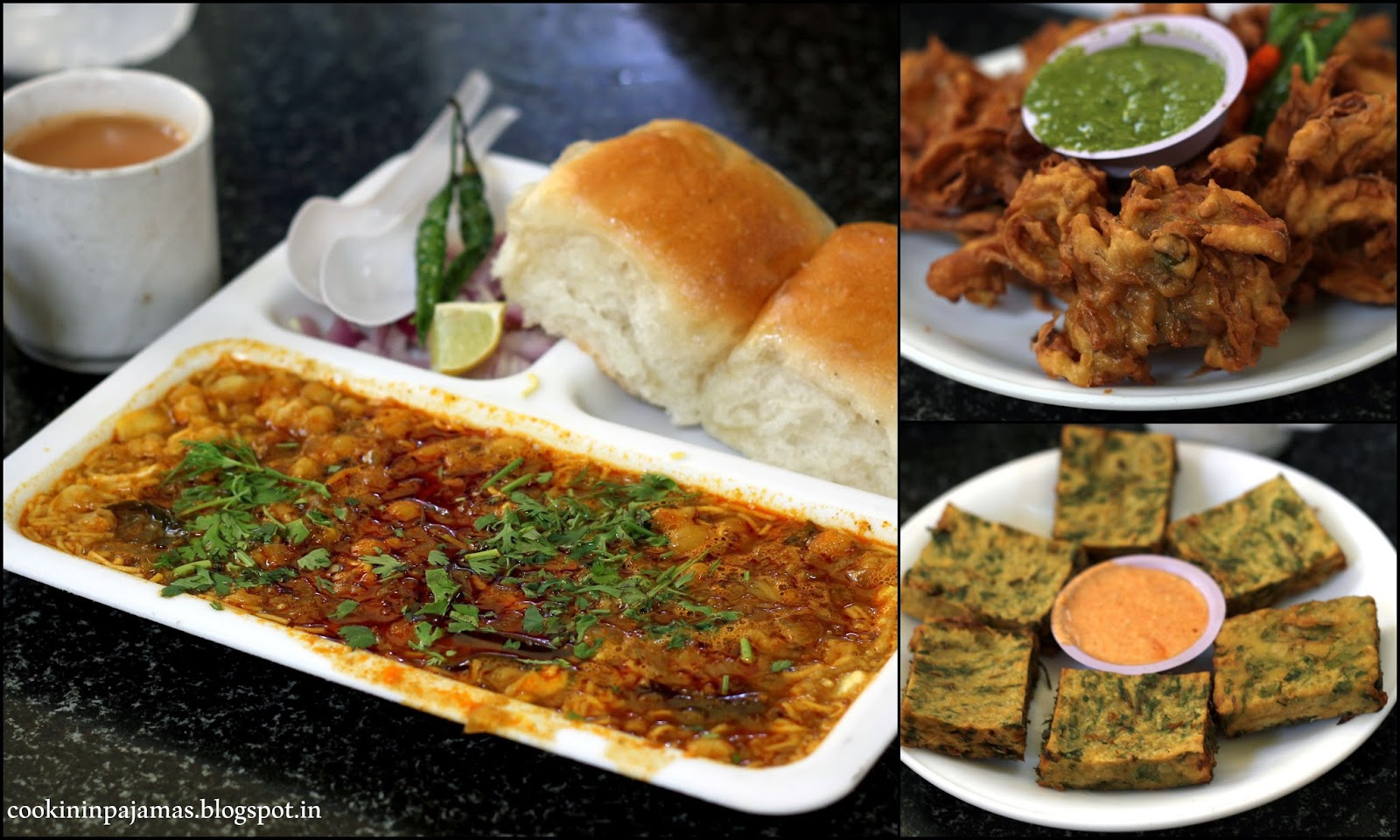
Misal-pav, Kanda bhaji and Kothimbir vadi
Pune is a city full of history and culture. With forts, parks, and home to the most famous Lord Ganesh (Dagdusheth), Pune attracts tremendous tourists from all over world. Located on the bank of Mutha river, Pune was the first capital of the Maratha Empire under Chhatrapati Shivaji Raje Bhosale. Now known as the IT hub and a city with lots of educational institutes, Pune resides a lot of migrants as students and working people. And though there is a lot of international cuisine popular in Pune nowadays, the traditional flavours of Pithla Bhakri, Misal pav, Puran poli and Bhelpuri is unbeatable.
A special mention here about the Landslide that occured about 104 kms ahead of Pune in the village of Malin that killed about 136 people. Prayers to those who lost life and much more... Read More.... The landslide is said to have occured due to increased activities by humans for farming and road constructions. More and more cutting of trees, and building of concrete is inviting disasters all over, and i wonder when people will understand the importance of planting trees.
Source : Google images
Well, coming back to the post...During our stay at Pune, my father-in-law suggested we visit "Sinhagad Fort". I had some vague memories of visiting this fort as a kid during one of our family outings, and so the idea of visiting it again got me and hubby thrilled. We had time at hand, the sun-God favoured us that day and it was such a pleasant lovely climate. To top it all my father in law mentioned that the traditional "tapris" of pithla Bhakri and matka dahi is still available on top. Now that made me jump in the car straight away ! Food really gets me going :)
The journey was as exciting, with roads of twists and turns driving up-hill (and to be honest, at a point or two, the turns were so sharp that it got my adrenaline high, but the drive was enjoyable and we safely managed it through)
Since we went on an odd-day, there was no rush. My father in law mentioned that on weekends, and especially in rainy season, the place gets so crowded that people have to park their vehicles halfway and climb the rest on foot. And special mention here for my father in law, who at the age of 65, often takes his bike uphill with a friend to enjoy some traditional pune delicacies. He is full of energy and enthusiasm and would give a complex to youngsters anyday :)
My Father-in-law posing
So we reached, and were greeted "Namaskar" by the man selling shelled peanuts and raw mangoes, just at the entrance where one has to start climbing about 300 odd steps. There is something so simplistic about the people we met there, that the honesty and humbleness shows on their face. Their faces have stories to tell and they are keen to help you, come what may. Yes, there are people who would have vested interest of you buying stuff from them, like a pot of curd for INR20 or a slice of cucumber for INR10. But when you hear the efforts they take to get all the ingredients right on top, you don't mind paying them their due share.
Sinhagad is a popular destination for trekking enthusiasts who climb the hill from the base village of Sinhagad. But since we had 2 elders (my father in law and my mom) with us, we took the car half way (yes, the roads are pretty good) and from there, we had no choice but to climb up the steps. Sinhagad falls on the Bhuleshwar range of Sahyadri Mountains of Maharashtra and was previously called Kondhana. The caves and carvings in the Kaundinyeswar temple gives the proof that this fort was built about 2,000 years ago and named after the sage Kaundinya.
The Battle of 1670: Though Sinhagad saw many battles, the most famous was the one fought by the general of Shivaji Maharaj named Tanaji Malusare. He and his troops climbed the fort with the help of Ghorpad (common Indian monitor lizards), to whom they tied ropes and sent crawling up to the ramparts. Fierce battle occured between UdayBhan and Tanaji in which Tanaji lost his life but won the fort. A bust of Tanaji is commemorated atop as a memorial.
The name: On hearing about Tanaji's death, Shivaji raje said, "Gad aala pan sinha gela" meaning to say, "we won the fort, but lost the lion" and so the name fell as Sinhagad (fort of a lion) from Kondhana.
We reached atop enjoying the small stalls on the trail selling titbits to keep you going. Before starting to explore the fort, we couldn't help but eat a plate of "Kanda Bhaji". Also known as "Khekda bhaji " (Khekda- crab, since they look like one), this deep fried fritters are served along with some really hot and spicy chutney. But enjoying these hot bhajis with some cool breeze and a view of the valley from top, you feel you are in heaven!
Khekda Bhaji
We finished with a pot of the special "Matka dahi" (pot-curd) from one of the well known mingling female there "Chorge Mausi". She followed us all the way from the foot of the hill to the top, serving also as our guide, so we take the curd-pots from her :). We got a free guide and some delicious curd which we were anyway going to buy. But jokes apart, she seemed one genuine lady who works hard to earn her daily living. She gets these curd-pots from her home, Kalyan village seen from the Kalyan Darwaza of the fort.
Chorge Mausi and the famous curd-pots
Then we started our tourist exploration and saw some breath-taking views from the top. The wind-point being my favourite, it was so breezy that we had to hold each other to stand straight.
There is a memorial of Rajaram (Shivaji's youngest son), Kondhaneshwar temple, Kali temple, military stables (as the fort is part of training at National Defence Academy, Khadakvasla) and two gates Pune Darwaza and Kalyan Darwaza.
And by the time we finished seeing all this, we were famished. Oh, not to forget, we had a canine friend guide with us throughout our journey. And another one joined too. She was too docile and sweet and we had to give her buiscuits :)
So we sat down below a huge tree on a "chatai" (Mat) and ordered the ever-famous Pithla-Bhakri. Pithla is basically chickpea flour cooked in water along with onions and other spices. Bhakri is a roti made with jowar or bajra, or sometimes with rice flour. We also ordered a plate of Baingan Bharta for change of taste but didn't quite like the taste as compared to the Pithla. Served along with onions and red chutney, this combination is a hit and one specially must visit the fort to eat it.
The cooking method is still traditional, and the taste is as authentic or it just tastes better with the view and the natural ambiance. Whatever it is, we had fun looking at the lady making Bhakris pressing with her hands in her little tapri that even had a "chul" (traditional stovetop where cooking is done burning wood and coal).
With our stomachs full, we finished the meal along with some more pot-curd from Chorge Mausi and started walking back towards our car. And there we saw the Kulfi wala! Remember I had mentioned about him in my post of Mango Kulfi!! So how could we not taste one of these? And the taste was just the same that took me back to my childhood days, and yes, this malai kulfi was for INR20 :) But all worth it!
Thus ended our adventurous trip to the fort, and by the time we went home, it was already siesta-time for us and all others :))